

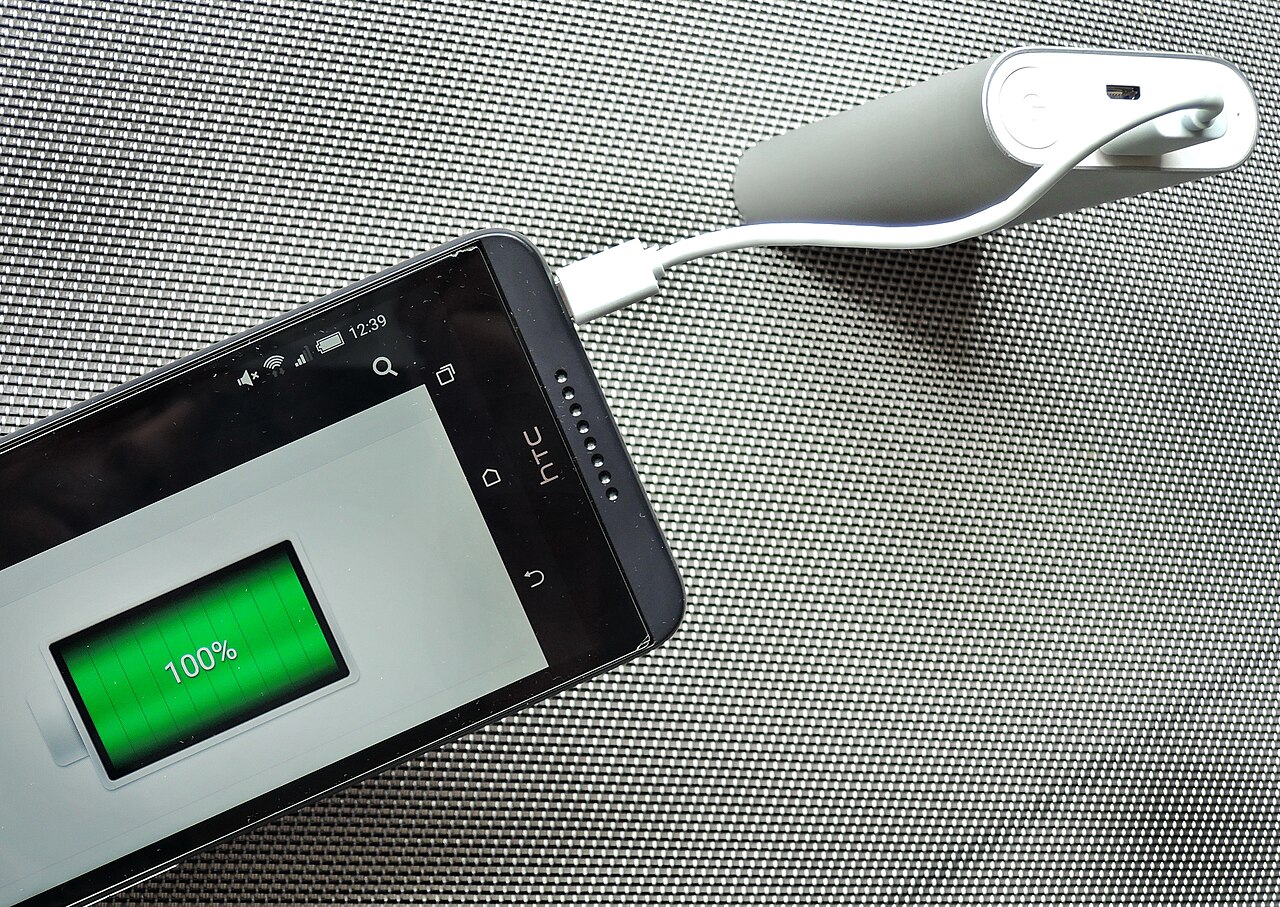

A power bank looks simple: a battery in a box. But two models with the same number on the label can behave very differently in daily use. This guide explains the specifications that actually matter so you can pick one that fits your phone, your travel habits and your budget.
1. Understand capacity (mAh) and what you really get
Capacity is printed in milliamp-hours (mAh). The catch is that this number is measured at the internal battery cell’s voltage, usually around 3.6 to 3.7 V, while your phone charges at a higher voltage. Add conversion losses and heat, and a power bank typically delivers roughly 60 to 70 percent of its printed capacity to your phone.
As a rough example, a 10,000 mAh power bank may give you about 6,000 to 7,000 mAh of usable charge. If your phone has a 4,500 mAh battery, that is around one and a half full charges. Use this as a rule of thumb rather than an exact figure, because efficiency varies with cable quality, charging speed and temperature.
2. Pick a size that matches how you use it
- 5,000 mAh: slim and pocketable, good for an emergency top-up.
- 10,000 mAh: the everyday sweet spot for one to two phone charges.
- 20,000 mAh and above: better for travel, multiple devices or tablets, but noticeably heavier and slower to recharge itself.
Be sceptical of very small, very light units claiming huge capacity. Battery cells have physical limits, and exaggerated capacity claims are a common red flag.
3. Check the output power (watts) and ports
Output determines how quickly your device charges. Look for the maximum output in watts on the label, not just the number of ports.
- Around 18 to 22.5 W is enough for most smartphones.
- 45 to 65 W USB-C Power Delivery is what you need if you want to charge a laptop.
- Multiple ports usually share the total output, so charging two devices at once can slow both.
Your phone also has its own maximum charging speed. A power bank cannot push a phone past that limit, so a higher-watt bank does not automatically mean faster charging for every device.
4. Look for useful extras
- USB-C in and out: lets one cable both charge the bank and your devices.
- Pass-through charging: lets you charge the bank while it charges your phone.
- Clear charge indicator: LEDs or a digital display showing remaining percentage.
5. Safety and travel rules
Power banks contain lithium batteries, so quality and handling matter.
- Buy from a seller who provides a proper invoice and warranty, and check for the compliance markings required in your country.
- Stop using a power bank that swells, gets unusually hot, or smells odd, and do not charge it under a pillow or on a bed.
- Most airlines require power banks to be carried in cabin baggage, not checked baggage, and commonly limit them to about 100 Wh. To estimate watt-hours, multiply mAh by the cell voltage (about 3.7) and divide by 1,000. A 20,000 mAh bank is roughly 74 Wh. Always check your airline’s current rules.
Quick checklist before you buy
- Capacity that suits your day, remembering you will get around 60 to 70 percent of it.
- Output wattage that matches your device.
- USB-C support and enough ports.
- Clear warranty, invoice and compliance markings.
- Realistic size and weight for the capacity claimed.
Choosing on these points instead of the biggest number on the box will usually give you a power bank that is safer, lighter and more useful.
How to use and store a power bank so it lasts
Lithium batteries age faster with heat and with repeated deep discharge. Avoid leaving a power bank in a hot car or in direct sunlight, and do not use it while it is packed tightly in a bag where heat cannot escape. Recharge it before it is completely empty when you can. If you will not use it for a few weeks, store it partly charged in a cool, dry place and top it up every couple of months so it never sits at zero. Use the cable supplied with it or a good-quality replacement, because a frayed or cheap cable can overheat and waste energy.
Common myths about power banks
- “A bigger number always means a better power bank.” Capacity is only one factor. Output power, build quality, safety circuits and weight all matter. A 10,000 mAh bank from a reliable maker is often more useful than a bulky 30,000 mAh bank you never carry.
- “Fast charging ruins the phone.” Phones and chargers negotiate the speed, and the phone controls how much power it accepts. Problems usually come from heat and low-quality chargers, not from the technology itself.
- “You must drain it fully before recharging.” This was advice for very old battery types. Modern lithium batteries do not need it, and full discharges are actually harder on them.
- “All cables are the same.” A thin, poorly made cable can limit charging speed and get warm. Use a cable rated for the power you expect.
Power bank or charging case?
If you only need a few extra hours for one phone, a slim 5,000 mAh power bank or a phone with a strong battery may be enough. If you travel, work away from sockets or carry a tablet and earbuds as well, a 10,000 to 20,000 mAh bank with USB-C output is more practical. Think about the situations where your phone actually runs out and choose for those, rather than for the largest specification.
Frequently asked questions
How long does it take to recharge a power bank?
It depends on capacity and input power. As a rough guide, a 10,000 mAh bank charging at about 10 W takes a few hours, while faster USB-C input can shorten that. Larger banks take proportionally longer.
Can I charge my laptop with a power bank?
Only if the power bank supports USB-C Power Delivery at a wattage your laptop accepts, commonly 45 to 65 W. A basic phone power bank will usually not be enough to charge a laptop.
Is it safe to charge a power bank overnight?
Well-made power banks include protection circuits, but it is still sensible to charge on a hard surface away from bedding and flammable items, and to unplug it once it is full when convenient.
How long does a power bank last?
Batteries are usually designed for a few hundred full charge cycles before capacity drops noticeably. With sensible use, many people get several years from a good power bank. If it swells, overheats or holds very little charge, replace it.